
The Power of Living and Learning on SLU’s Campus

I want to be clear, the point of my writing this article is to discuss the impact of attending the Jan. 29 Q&A about Venezuela, and to urge fellow American students to wake up and break through the seemingly politically safe and unaffected North Country bubble.
To begin, I must acknowledge my positionality; I am a white American woman who has the privilege of learning about xenophobia and racism while never experiencing it firsthand. Growing up, I had very little education or introduction into true effects of American imperialism. History classes covered the American Revolution, westward expansion and a sprinkling of European politics. I have heard similar curriculum stories from those educated in the American public school system. Coming to St. Lawrence University and sitting in on classes where different countries and political systems were not only discussed, but also represented, by international students enlarged my worldview. For the first time, American supremacy was deconstructed. The effects of U.S. military interventions, briefly mentioned in textbooks or seen in passing Instagram scrolls, could no longer be ignored.
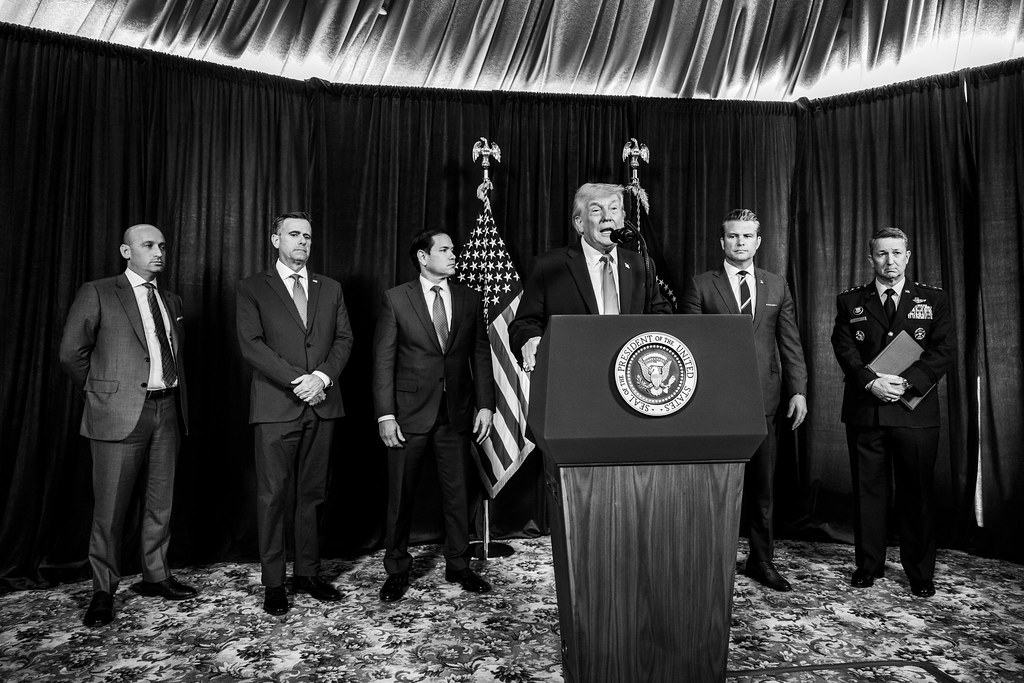
Not only are we learning from political history, but we are also witnessing in real time an attack on the ideals of democracy, international law and decency. We see the effects of the Trump administration every day on social media, from reading the testimonies of survivors in the Epstein Files to watching his advisors lead the killing and capturing of often innocent civilians (according to Transactional Records Access Clearinghouse, 73.6% of those detained by ICE have no criminal conviction). I write from a critical lens of Donald Trump and his actions, but I also want to acknowledge the diverse and nuanced perspectives on the invasion of Venezuela.
On Jan. 3, the U.S. invaded Venezuela and captured dictator Nicolas Maduro. For many Americans, it seemed like just another day of political decisions, but for the 7.9 million Venezuelans abroad—and those who remain in the country—the day was filled with extreme anxiety, and for many others, hope. American news outlets pushed a simple narrative that obscured the many complexities of the Venezuelan political landscape. I was confused why only praise for Trump filled my social media timeline. My lack of understanding, rooted in ignorance of the specific political situation, made it imperative that I attend the Q&A and hear about real-life experiences.
I am now sharing the important takeaways from the event. Following more than 25 years under the Chavista regime, Venezuelans have requested an intervention from the U.S. since approximately 2017, after exhausting all possible political and electoral alternatives. However, it is critical to note that Venezuelans have done so in hopes of restoring democracy in their country. Therefore, it is important to call out much of the political rhetoric that exclusively focuses on U.S. supremacy and control of the oil resources in the country: (1) the oil has always been Venezuelan, and (2) this political situation is more complex than just a conflict over oil ownership.
The invasion cannot be undone, and the conflicting feelings of happiness and anxiety experienced by Venezuelans cannot be debated. Americans now need to educate themselves and support Venezuela’s transition to democracy. No one can profit if an authoritarian government is still in power. Maduro is gone, but his party—and most of his close allies—are still ruling the country. Amid multiple economic reforms directed by Washington, Venezuelans are currently calling for the quick release of the remaining 687 political prisoners and for the closure of all torture centers across the country. Instead of arguing about oil history, it is important for Americans to recognize and support this demand.
To reiterate, I want to acknowledge the power of learning from and uplifting the voices that our government has silenced. This situation is politically nuanced and should not be viewed solely through an oil or economic lens. The true aspiration of Venezuelans is to establish democracy in their country, and that should never be forgotten.