


The ‘Carpenter’ and The “Whore”

WARNING: THIS REVIEW IS NOT FOR PEARL CLUTCHERS
The first time I remember being scandalized by art—which, yes, the foreboding song and video is a work of art by any standard—was Nicki Minaj’s “Anaconda.” At nine, my friend and I watched the music video on his four-by-two iPod: essentially, softcore pornography. Minaj’s scantily clad bare ass jiggling like a Jell-o cup was both obscene and enlightening.
Every couple of years—when an election cycle isn’t dominating discussion—a phenomenon occurs online. The talking heads project their poorly channeled societal discontent onto an artist or celebrity: Kim Kardashian. Taylor Swift. Even Drake. While Sabrina Ann Lynn Carpenter’s controversy may not reach memorable heights, if you haven’t seen the hysteria her latest album cycle has caused, you’re existing in all the wrong places.
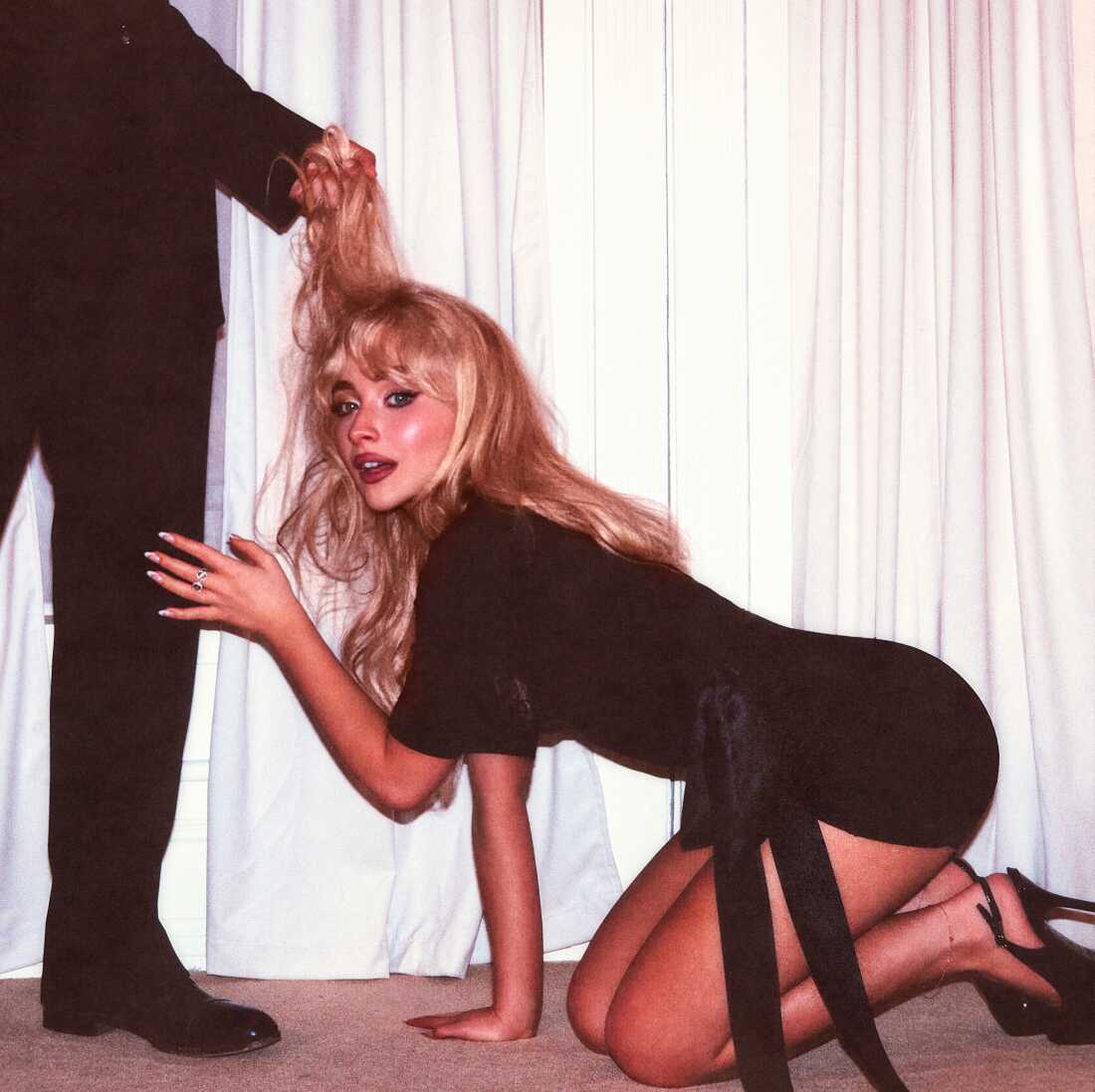
Before seeing discourse about the cover for Man’s Best Friend—Carpenter’s technical seventh (but canonically second) studio album—I immediately formed an opinion: It was genius. Who, if not Sabrina Ann Lynn herself, has been doing salaciousness in such a shameless, sexually-charged way? When was the last time Nicki Minaj imprinted on pop culture stans her questionable online presence? Does Doja Cat’s biting crassness in songs like “Demons” compare? Do we have to fly overseas to view this incisive sexual exhibitionism, like UK Rapper CeeChynna’s raunchy breakout “Peggy?” On her knees, doll-like blonde hair pulled by an ominous, faceless male figure, Sabrina pleads her case. There’s no need to go overseas.
Because most are unfamiliar with satire or irony—in and of itself ironic considering those concepts run our generation—the cover sparked more than eyerolls. It was called degrading. Self-objectifying. Anti-feminist. Most who claim autonomous sexuality confuse regression for transgression: a mistake Carpenter won’t make. In her Sadeian pose of subjugation, the album cover differentiates Carpenter with one attribution: she is an aesthete. Despite being catapulted into relevancy after years on the unpromising path of post-Disney doom-gate, like Miley’s Bangerz, she found hers in the form of a caffeinated beverage: “Espresso.”
The album cover—especially the “god-approved” alternate version—is pure aestheticism. It’s redolent of Paul Schrader’s “Hardcore,” with the freedom of Paul Verhoeven’s “Showgirls” (and yes, Peter—gentilic euphemism aside—plus Paul and Mary = the perfect trifecta, thank you Britney), both films pervasive in niche, countercultural online spaces. The alternate cover shows Carpenter rising from dinner, wearing sparkling turquoise, adjacent to copycat crypto-bro clones, sticking out like a sore thumb—or, considering the album’s content, body. Do you get it now?
Carpenter’s strength, besides her humor, is inversion. Prior to releasing the video for “Tears,” she released the thumbnail as if it was a single. The photo itself features a phosphorescent, Elizabeth Taylorian-looking Carpenter, face damp with Old Hollywood tears. The song’s reveal? The tears aren’t from her face, but trickling down somewhere else. When did we last hear an ex-Disney-er sing “wet?” This is horny Joni Mitchell; porous Stevie Nicks during Fleetwood Mac’s interpersonal drama cosplaying as something less—it’s not. Man’s Best Friend isn’t JUST taboo—throughout, Carpenter doesn’t just sing about wanting sex. On “Tears,” she sings about the arousing thought of someone “being a responsible guy.” She moans when he “[assembles] a chair from IKEA.” Carpenter cares about her environment: all she wants is someone to assemble furniture correctly.
Another great thing about Carpenter is how the music compares to her personality. With Chappell Roan, what you see is what you get. With Carpenter, especially those who grew up with her on Disney, it’s different. In interviews, she’s sardonic but deadpan, restrained. While her tone may be clearer than Visine in the music, her lyrics are dramatic, grandiose, and—overused as the word may be—”camp.”
“We Almost Broke Up Again” sounds like an original Glee song. And she knows it. She includes a line straight from a Judd Apatow romcom circa 2008: “[the breakup] was so hard / I almost gave him head.” Though the comparison is redundant, her peer Olivia Rodrigo’s GUTS showed evolution in conveying generational anxiety. On “ballad of a homeschooled girl,” she captured social mortification’s fortitude. Carpenter conveys wall-to-wall bedroom angst that others only scratch the surface of. If Short’ N Sweet was inebriated Tammy Wynette performing originals, Man’s Best Friend is the reticent Amy Dunne-type in the corner, biting her tongue, fearing friend-group exile. She’ll drink a PBR with you, and after too many, may crack it atop your mountainous head.
I didn’t force myself to like this record—it’s good pop music, that simple. During quieter moments like “Never Getting Laid,” I could see why people labeled it “boring.” But what constitutes a “boring” song when its point is to move consistently? I’d award Man’s Best Friend the college-kid-core label—something for everyone to relate to. Guys—put down the Carti record we’re all sick of, and try this for fun.
To deem the album void of thought-provoking moments discounts its holistic artistry. Why isn’t “Go-Go Juice”—the title a hilarity alone—consumed with the same consideration as trauma-informed workshop art? It’s an honest confession about needing liquor as a social lubricant, not caring that “happy hour [can come] at 10 [o’clock] on a Tuesday.” The only disappointment is “Don’t Worry I’ll Make You Worry”—not because it’s lackluster, but because it has potential for more. Sonically ethereal in its opening, Carpenter’s detached sarcasm seems dissonant and misplaced in an unsatisfying way.
The riotous reaction to Carpenter displays two things: singers’ short shelf lives today and how concerned people still get over prurience. Meanwhile, French New Wave viscera-spilling, Martyrs-style violence is everywhere—still a centennial conundrum. What does Carpenter do? She martyrs herself for herself and for those who understand.
Sabrina Carpenter doesn’t care if you clutch your pearls or rip them off. With Man’s Best Friend, she’s after the whole pearl necklace.